Thursday, August 13, 2015

Urquhart's Law: really?

Sorry, this is just fluff, but this morning's Campus Morning Mail another bit of fluff that I felt drawn to comment on:

Urquhart’s (really old) other law
CMM is a great believer in Urquhart’s Law of Political Communication, (as per the original House of Cards) that the correct response to scandalous statements is “you may say that but I could not possibly comment.” But it turns out another Urquhart had a different law. A reader found it and wanted to know what it means; “the inter-library loan demand for a periodical is as a rule a measure of its total use.” Readers under 50 ask an old librarian why anybody would need to get a library to loan a printed journal
And mystupidbrain wondered about the common sense assumption of using inter library loan to measure a journal's use.  Even in a print world that makes no sense.  ILL is for items you don't have in your library. Arguably what you do have in your library is the most used stuff, or the stuff your clients most want (because it's easier than sending ILL requests).

Assuming other libraries do the same, and that there are a core collection of journals everyone has (say, for example, New Scientist) - so you will never get a request for it from another library. So to say the journal is low-use because no-one ILLs it is patently flawed logic.

What ILL requests might tell you is how unique a particular subscription is - you may be the only library subscribing in the country.  I think your outgoing ILL requests tell you a lot more about your collection, and its relationship to your clients' needs, than incoming requests ever could.

Of course all that runs through my head without knowing anything about the context of Urquhart's Law - I'd never heard of it.  So I looked it up.

Donald J. Urquhart (1909-1994) (BSc, PhD) was a revered figure in British library circles. He founded the  National Lending Library for Science and Technology in the early 1960s, against the opposition of the then current thinking of much of the library profession. It was a response to the post-war explosion in scientific information. Eventually the NLLST was absorbed by the British Library in 1973 to become the revered British Library Document Supply Service. 

Urquhart's Law was an application of scientific methods (specifically probability) to collection management and document delivery for an entire (huge) sector  of research - not a particular library's clientele. He published it in 1977, it was still being referenced in library science lit in the last decade.

I feel like a first year library student again. I know nothing John Snow.
Urquhart's autobiographical history of his creation - available via Amazon (who are the source of the image)

Monday, March 2, 2015

Readings & Past Exams/Reserver Online/Masterfile access issues

Not of interest to anyone outside of JCU, just using my blog to list the workarounds for a local issue:


Have logged this in ServiceNow:

Connection to Masterfile is causing warning errors in all 5 major browsers

Apparent cause is mfileprod.intra.jcu.edu.au using masterfile.jcu.edu.au certificate

Affects staff embedding Digital Library items in LearnJCU and the Masterfile web UI

Student access to Readings & Past Exams appears to be unaffected

*Firefox*

Allows login but blocks display of PDFs

Workaround: Grey shield can be used to enable content view

*Chrome*

Your connection is not private

Attackers might be trying to steal your information from masterfile.jcu.edu.au (for example, passwords, messages or credit cards).

This server could not prove that it is masterfile.jcu.edu.au; its security certificate is from mfileprod.infra.jcu.edu.au. This may be caused by a misconfiguration or an attacker intercepting your connection.

Proceed to masterfile.jcu.edu.au (unsafe)

Workaround: click on “Proceed to masterfile.jcu.edu.au (unsafe)”

*IE*

There is a problem with this website's security certificate.
The security certificate presented by this website was issued for a different website's address.
Security certificate problems may indicate an attempt to fool you or intercept any data you send to the server. 
We recommend that you close this webpage and do not continue to this website. 
Recommended iconClick here to close this webpage.
Not recommended icon Continue to this website (not recommended).
More information  More information 

Workaround: click on “Continue to this website (not recommended).”

*Safari*

Cannot Verify Server Identity

Workaround: click on “Continue”

Cheers, Alan

Friday, February 6, 2015

Link Resolution Quirk in ATSM Journals (Resolved)

ATSM have fixed this issue (see postscript)
No great drama here, just thought this might interest people who get frustrated with Link Resolvers but don't know who to blame.

This issue reported by a staff member who, using Summon, got a 360 Link to:

Zhang, F., Guo, S., & Wang, B. (2014). Experimental research on cohesive sediment deposition and consolidation based on settlement column system. Geotechnical Testing Journal, 37(3), 20130054. doi:10.1520/GTJ20130054
Which demanded payment (add to Cart and pay $25.) for an article we have subscription access to:
 
Our sub was active in 360 and you can browse to the article from the eJournal portal and get access. What the heck is going on?

What's Going On?

360 Link resolves to:
http://www.astm.org.elibrary.jcu.edu.au/DIGITAL_LIBRARY/JOURNALS/GEOTECH/PAGES/GTJ20130054.htm
so it's clearly going through EZproxy.
Browsing from the ejournal portal you get this URL:
http://www.astm.org.elibrary.jcu.edu.au/SUBSCRIPTION/DIGITAL_LIBRARY/JOURNALS/GEOTECH/PAGES/GTJ20130054.htm
i.e. SUBSCRIPTION in the exact same path inserted after the domain name.

So why the different URLs for the same article?  I'm assuming the ATSM platform has been set up so that objects in the SUBSCRIPTION directory get an IP range check to see if you have access.  But for public access to abstract and sales they have cloned everything but the PDF into a DIGITAL_LIBRARY folder in root and have set up the DOI to point at that rather than have the DOI point at IP restricted pages.
From previous experience 360 Link DOI via CrossRef overide any OpenURL 2 publisher conversion scripts that 360 Link might have.

So ASTM's solution is pragmatic and unsophisticated - and hamstrings our users coming from any source other than the journal TOC.

I've submitted a request to Proquest for any workaround they can implement. I thought maybe parsing the DOI and inserting the SUBSCRIPTION folder in the path - but that assumes that 360 Link plays any role in handing the DOI link back to the client. I guess another option is for Proquest to add ATSM to their list of IEDL publishers.

If only there was only one publisher platform for ejournals.

Postscript

I noticed in my endless rechecking of red flagged jobs for follow up that ASTM have fixed this issue by coding a check of the requester's IP address and if it matches a subscriber prompting the user whether they wish to access the full text under that subscription:
The subscriber name in our case looks like it's come from a very old registration with OCLC/NLA but that's a job for another day.

It works the same via the link resolver as it does just doing a straight dx.doi.org resolution (so the 360 Link helper frame isn't causing an iframe conflicts).

I don't know if logging a request through Proquest had any impact as neither Proquest or ASTM have contacted me. But happy to close the job.

Monday, January 5, 2015

Random notes from "Data for ROI and Benchmarking Ebook Collections"

I registered for Library Journals webcast "Data for ROI and Benchmarking Ebook Collections". This webcast can now be viewed On-demand." but as usual couldn't make it but they did record it so - I'm just writing down the points that stuck out for me.

Ying Zhang (Acquistions Librarian from University of Central Florida) did some analysis of her institutions use of ebooks acquired using one of three possible purchase methods. She measured ROI by calculating how many uses ebooks got for each $10 invested in each of the three methods.

Patron Driven Acquisition (PDA) 

Titles acquired based on user demand
2.7 uses/$10

Firm 

Titles selected and acquired individually
0.5 uses/$10

Package

Large pre-defind static collections acquired as one time purchases
4.4 uses/$10

Although this ROI measure makes it look like 'Package' is the best for ROI Ying makes the point that each method has it's place:
  1. Package has the highest ROI but is stagnant and use will drop over time. The library and it's users can't weed out unwanted titles or add wanted ones.
  2. Firm is how you shape and customise your collection, but has the highest admin costs.
  3. PDA provides a low input mechansim by which the collection updates itself to the user's needs.
Michael Levine-Clark Associate Dean for Scholarly Communication and Collections Services University of Denver examined a some global usage data on 340k+ books from EBL from one provider that covered a bunch of libraries.

He found that titles were roughly evenly spread between Social Sciences, Arts & Humanities, and STEM.With Social Sciences having 15% more titles then STEM, which in turn had about 1.5% more titles than Arts & Humanities.

Reverse engineering from his bar chart I get a 'use ratio' for Social Science titles that is 32% higher than STEM titles (in spite of the higher number of titles) which in turn has a 'use ratio' of 15% higher than Arts & Humanities

This is sort of counter intuitive given A&H perceived reliance on monographs, but as Michael continues to look at the stats interesting things pop up:

  • STEM titles average far more pages per session (scanning?)
  • Arts & Humanities spend the most time per session and per book (immersive reading?)
  • His graph by LC number of number of titles available compared to usage shows that L(Education) titles get he most usage followed by N J T H M R D E, Z gradually tailing off with the last 5 classifications being Q P K U and F
He concludes that just using cost per access does not tell the true story of how your resources are being used.


Tuesday, April 1, 2014

Knowledge Unlatched - Open Access for all, funded by libraries

We've become a charter member of the 'Knowledge Unlatched' scheme/project/pilot along with over half of Australian university  libraries (we finally beat New Zealand at something. Just.).

Basically it's an attempt to pay publishers for book production to make items open access (via Creative Commons licensing).  The FAQ explains the what, why, how, who, when.  The site says the items will be available through OAPEN.org and the Hathitrust - though my rudimentary tests show that so far they are just available through OAPEN. Interestingly the titles can also be purchased (from publishers, Amazon etc). Also interesting is that they are in Google Books, but not as full text.

Membership of the pilot has closed, but they are taking expressions of interest for the next stage.  The more libraries that join the less we all pay per OA book . That sounds appealing to me.

The pilot worked out at about $46 per book - and we've purchased global open access for all people, not just our constituent populations.

I also like that publishers can still sell the books if someone wants to own a copy. The partner publishers are for the most part University Presses but with success maybe it will be seen as a viable model for others. 

KU in 60 Seconds


I sent a feeler out to Proquest because I suddenly had nightmare visions of IP blocking of Hathitrust content for non-North American countries. Not realising that of course Proquest have long since sorted the Hathitrust into multiple collections to bypass this issue and we track the global open access part in 360 Core for inclusion in Summon and 360 Link.

Anyway one of my key themes for this year's work is increasing exposure of Open Education Resources through Summon so getting KU in our instance of Summon sounds like a nice kick start.

Monday, March 31, 2014

Windows 8, EZproxy and Secret Sauce AdWare

As of writing we've had 3 reported cases of Windows 8 not displaying content through EZproxy. Basically any proxied content doesn't display - no errors, no friendly error messages, just a blank screen. Everything else 'webby' works fine.

With 360 Link 1-Click with the helper frame you see the helper frame (it's not proxied by EZproxy) but the iframe content is blank - viewing source shows that no html has been transported to the browser.

Originally I suspected some sort of mixed content problem (we've had a lot of that this year in Chrome and Firefox) but no grey shields - or possibly a caching issue (we've had problems with expired EZproxy sessions being cached so students are denied access to content but are not prompted to start a new session. Scarily it affects all three of the main browsers (IE, Firefox and Chrome). Even connecting to the EZproxy login screen gives a blank screen.

But thanks to ranking smart guy at our IT Helpdesk Anthony Warrell we have a diagnosis and resolution. As he says:


The culprit turned out to be a piece of Ad-ware called Secret Sauce which had somehow managed to sneak past Norton 360 and find its way onto her computer. The tool I used to remove it is called ComboFix. I would not recommend providing the client with self-help instructions on how to clean their machine but have them obtain IT assistance with running ComboFix and removing the Ad-ware.
 
Instructions on using ComboFix can be found here: http://www.bleepingcomputer.com/combofix/how-to-use-combofix
 
Malwaretips.com says: "Some of the programs that are known to bundle Secret Sauce include 1ClickDownload, Superfish, Yontoo and FBPhotoZoom".  All three students mentioned seeing unsolicited advertisements in their browser. Malwaretips says that product images in Facebook will display a 'See Similar' button that links to the ads they earn money for clicks.

We're fortunate that ITR are willing to perform the clean for on campus students but I'm not sure how we'll help an off campus student - particularly when part of the process is restarting Windows 8 in safe mode, so RDC or similar remote operation isn't an option.

I hunted high and low for any mention of the way Secret Sauce interferes with EZproxy and came up with nothing. Anyone else at other institutions seeing this? No mention of it in OCLC's user support areas.  Are we the canary in the coalmine or is there something unique about our network environment exacerbating this?

I suspect that Secret Sauce doesn't like EZproxy rewriting URLs but I really don't know.  I have no idea how widespread Secret Sauce is but have written to OCLC asking if by any chance they've heard about it.

Obviously prevention would be the ideal solution, but how do you get people to be more suspicious of free software, especially when half the time we're advocating for open source and open access? Even something as seemingly obvious as always selecting the 'customise' option when installing software?  Even Java wants to install the Ask Toolbar.

Anyway I'm posting this for the future you who is googling 'Windows 8 EZproxy blank screens'. I hope it helps.

Sunday, February 9, 2014

VALA Day 1 Wrap Up

The first plenary was delivered by Christine Borgman (UCLA) talking us through the issues around research data management.

Persistent URL: http://www.vala.org.au/vala2014-proceedings/vala2014-plenary-1-borgman

She laid out some cautionary thoughts - librarians thinking they can handle 'data'  the way we handle other information bundles is naive in the extreme. She was complimentary of Australia's 'broad' approach to research data management, but a black box approach to data obscures the complexity of what we are dealing with.
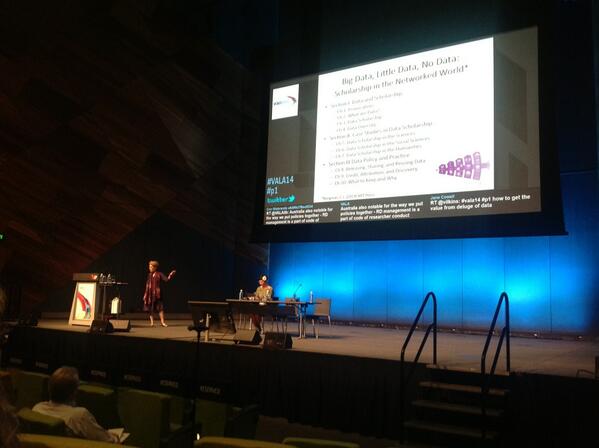
A preview of Borgman's upcoming book 'Big Data, Little Data, No Data


No-one can actually define data and even examining specific cases multitudes of complexity occur:
Different fields have different technologies, behaviours, and structures for dealing with, presenting and interpreting data. Different geolocations within a field will have significant variances.

Some of the issues to be dealt with revolve around the personal. Researchers often feel the data they have is their 'dowry' and makes them valuable to their institutions and sharing diminishes its value.  Others don't mind sharing but they want personal contact with the person they are sharing for a number of reasons, and feel uncomfortable with unmediated access.  On the receiving end researchers don't necessarily like using someone else's data because of issues of trust.

When you start examining the data, or as I coined it 'metareality', even more issues of complexity arise.  One neat example was the fact that there are several taxonomies for describing drosophila genomes - how open is the data if it's coded in a way the user doesn't use?


And what about access? At what level of granularity do you provide access? A single link to a zip file of everything? URIs for individual files, or as Borgman mentioned 'A DOI for every cell in a spreadsheet'?  What about format? What role do we have in ensuring the format is accessible over time?

What are the effects of knowledge infrastructures (institutional, national, discipline) on authority, influence and power? Recommended reading: http://knowledgeinfrastructures.org/

A strong case was made for skill sets not normally associated with librarians - economics, records management (determining at time of storage how long you're going to store it) and archival practice (provenance is a huge factor in building trust). It's long been said that some areas of JCU assume the Library will take on maintenance of research data management - we really need to be aware of just what is involved and how much we will need to be embedded in research areas as partners and the resources and skills that will demand. In an aside Christine mentioned a 200 page book telling you how simple data citation is!

Hacking the library catalogue: a voyage of discovery

Persistent URL: http://www.vala.org.au/vala2014-proceedings/vala2014-session-2-kreunen

A kind of interesting talk from UniMelb's University Digitisation Centre (UDC) about the work it's 5.4 staff do particularly in trying to manage metadata for scans from the print collections and how they managed to scrape data from the catalogue  as automatically as they could.  I could relate to the speedbumps they kept hitting with things that should work but don't, for example they figure out how to get their catalogue to present a record in XML, but the scanning software wouldn't accept the XML as valid, but the vendor insisted it was, so workaround on workaround.

Marking up NSW: Wikipedia, newspapers and the State Library

Persistent URL: http://www.vala.org.au/vala2014-proceedings/vala2014-session-2-cootes

A cool project involving the NSW State Library and some interested public libraries that identified 20 volunteers to enrich wikipedia entries for local newspapers that had been digitised and added to Trove. Lots of liaison with Wikipedia because that community is very sensitive lots of changes in a narrow section. So the word was sent out that the volunteers would be doing work and that other contributors should be 'nice' while they found their feet. One interesting observation was that it was 'unlibrarianlike' to have to accept that once you've added content in wikipedia it is no longer 'yours' and you have no veto over how it's changed, any more than any of the thousands of people who actively contribute to wikipedia.

I think we should consider this as another step in processing records for NQHeritage. I think as a profession we should be augmenting and improving wikipedia with reputable resources. As was pointed out: Wikipedia is the 5th most popular site on the web - users are going to use it so lets make it better  - and expose our resources through this incredibly popular portal.

Journey into the user experience: creating a library website that's not for librarians

 Persistent URL: http://www.vala.org.au/vala2014-proceedings/vala2014-session-4-murdoch

I did a standing ovation at the end of this one. Loved that they went all Steve Krug on usability testing.  Loved the heat map (I will have find a way of creating one for our site through the Google Analytics data). Which effectively showed that 3 links were pretty much covering 90+% usage.

Jealous that their university web/marketing section trusted them enough to build templates outside the corporate  templates (in fact the library laid the path for the rest of the university.

Check out what they ended up with!
http://www.library.aut.ac.nz/


Influences of technology on collaboration between academics and librarians

 Persistent URL: http://www.vala.org.au/vala2014-proceedings/vala2014-session-5-pham

Report about an indepth case study of acadamic/librarian  relations revolving around information literacy training and the learning management system at Monash. Pleased to say we have moved beyond some of the problems identified (like lecturers not seeing why a librarian doing IL for their students would need access to the subject in Blackboard) but I think our advances are patchy.

Just accept it! Increasing researcher input into the business of research outputs

 Persistent URL: http://www.vala.org.au/vala2014-proceedings/vala2014-session-5-ogle

A report on the University of Newcastles improvements to automating the HERDC reporting and again it was nice to see we were more advanced in this area - their next big project was to integrate their research database with their institutional repository, something our Library, Research Services and ITR sorted a couple of years ago. I wonder what they would have thought of David Beitey's work on the Research Portfolios.

The day was rounded off by a roller coaster presentation 'Social media as an agent of socio-economic change: analytics and applications' by Johan Bollen from Indiana U

Persistent URL: http://www.vala.org.au/vala2014-proceedings/vala2014-plenary-2-bollen

Johan is probably best known for work showing a correlation between twitter 'mood' and stock market movements. Which came out of a project that assigned 'emotion' to tweets through 'big data' analysis applying Affective Norms for English Words (ANEW) which:
"...provides a set of normative emotional ratings for a large number of words in the English language. This set of verbal materials have been rated in terms of pleasure, arousal, and dominance in order to create a standard for use in studies of emotion and attention."
Turns out that 3 days after a spike in negative feeling in the twittersphere the Dow Jones will drop, and a positive spike will correlate with an increase after the same lag.

Bollen was engaging champion for the wisdom of crowds, pulling anecdotes and finding from all over the place to make his convincing case.

1 in 3 people in the world has internet access - North America topping the list with nearly 80% penetration and Africa at the bottom with it below 20% massive recent growth in Asia and the middle East.

If Twitter 'nation' was a nation only China and India would have more people, and analysing linkages and traffic can tell you much about the macro movements resulting from the micro actions of individuals.

Flickr (orange) and Twitter (blue) map created by Eric Fischer
While some think that the internet, by giving everyone a voice, will turn society into an 'idiocracy' Johan does not share this pessimism and gave a couple of examples where crowds do actually make better decisions than experts, and in fact showed us a mathematical formula (Condorcet's jury theorem) that shows a jury made up of people who are right even slightly more than 50% of the time gets more and more accurate the higher the number of jurors. Then pondered whether the current American political situation was because too many people are right just under 50% of the time which by the same formula magnifies the wrongness of the crowd.

Johan had 80 slides both whimsical and insightful, hope the video is up soon.

The finale was his mojito-fueled solution for research funding that eliminated the tortuous and wasteful process of writing and reviewing of proposals.  Basically allocate an equal share of the total amount available to all the researchers but require the researchers to give half to a researcher whose work they think is valuable, a bunch of checks would need to be in place, but you would be crowdsourcing research funding allocation to the researchers themselves.  The modelling shows that that any 'waste' would be less than the amount of resources spent in maintaining the current proposal/review system. Personally I worried that a standout researcher would receive way more money than required, but I wasn't Mojito assisted. Johan's explanation was much more cogent than mine.

Some links and thoughts  to ponder:
  • Digital Humanities experiment with big data http://www.themacroscope.org/
  • Mood analysis shows that negative tweeps tend to cluster in networks with each other
  • In networking terms a retweet is as valuable as the original tweet
  • Bollen mistrusts Altmetrics because the major drivers are media outlets, not individuals


For another view of all the bits I missed or mucked up try Deborah Fitchett's or Hugh Rundle's blogs.

Tuesday, February 4, 2014

Creating your own ebook #vala14 #bcb

Chris Cormack, with throbbing leg and nauseous belly, delivered a session bursting with so many ideas that I'm still putting together all the resources he provided.

After a greeting in Moari the author of Koha delivered a measured rant that put him more in the Aaron Swartz camp than the big publisher camp. My interpretation of his thesis is that digital publishing completely changes the 'book' business model, and powerful companies are trying desperately to preserve the old system where a book was a non transmittable, nearly non-replicable item of information. 
The system has to change, but it's unlikely the publishers will drive the change so Chris in 'Don't die like an octopus die like a shark' mode wants to show people how easy it is to create an ebook, to democratize access to the tools of ebook production. Ebook production is easy - but creating content is just as hard as it's ever been - but publishers don't create content, they control the mechanisms of publishing.

And that was just the start - I'll try and list the tools and thoughts around them.
First up he got us to log into an instance of BookType he'd set up in a couple of hours on a German host - he says any IT department could do it in an afternoon. BookType is the tool of choice of FlossManuals.

So we started on our books after about 5 minutes.  While we fiddle Chris kept coming up with related tools and thoughts like
  • Project Gutenberg has a self-publish option
  • By handholding our users through tortuous ebook platforms library staff are effectively unpaid 'groomers/promoters' for those publishers
  • TOR Books don't use DRM (the tool of choice for fabricating scarcity) but are still turning a profit
  • IE should not be used with BookType (actually the last two words are redundant
  • Using Calibre to publish your book in different formats (PDF, epub et al)
  • Using Google Docs to create and collaborate on the 'raw' content then use BookType to format it as an ebook
  • Libraries offering an inhouse ebook publishing service, a digital 'makerspace'
  • BookType can import an ebook from the internet archive, simply.
  • Using http://www.online-convert.com/ to convert between ebook formats (or anything else for that matter)
  • You can sell your ebooks via WordPress using the free ecommerce plug-in WooCommerce
  • Or you could host your ebooks on http://dpubs.org/
  • You can promote them using Open Publications Distribution System en.wikipedia.org/wiki/OPDS
  • Why not get your own Open Book feed reader!
  • Worried about version control? Flashbake monitors nominated directory creating versions of files
  • Pay what you want. Support charity. Get eleven extraordinary audiobooks.' Just giggles check out the weekly sales data to see which OS users pays the most on average (Scroll down on the Games page)
So many toys to play with! Do we have a role in epublishing? I would like to see us collaborate within and without JCU on open etextbook production, and Chris shows that the tools aren't the barrier it's the will and effort.

Monday, February 3, 2014

Brewing Your Own Linked Data #vala15 #bca

Well that session was exactly what I wanted!  Open linked data has been on my watch list since 2010 after seeing OpenCalais demoed at that years VALA


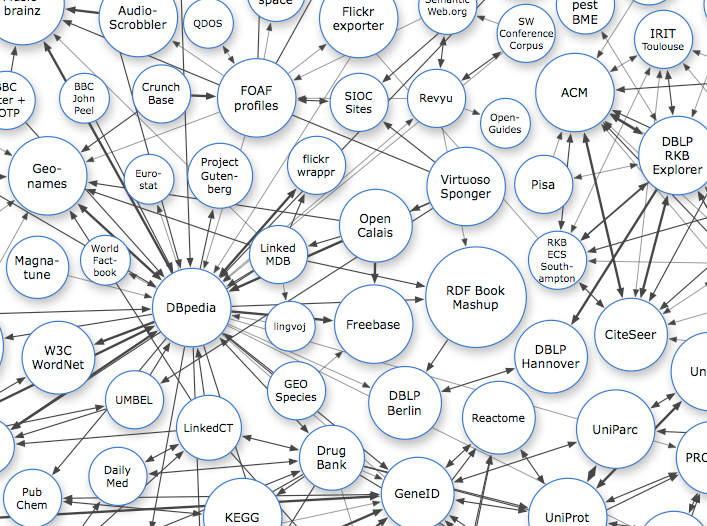
It was great to see under the hood and spakfil my limited understanding of what it all meant.  I liked that Tim and Paul be aware of 'Linked Open Data (LOD) Paralysis' (see image below) and keep dragging us back to practical uses.


So I now know RDFa is the defacto standard, that Google, Microsoft Bing and Yahoo actually cooperated.  Handcrafting your own linked data in html code gave us an object lesson in why you wouldn't only create this sort of markup using computers. But as the 'other' Tim and Paul point out - libraries already have this information stored in databases in a highly structured format, it just that once we publish it to the web we throw the structure out so it looks nice on a page.  Generating this same content with embedded Linked Open Data (LOD) from these databases shouldn't be hard.

LOD maintains the structure of the data (so it makes sense to computers) without changing how it looks (which makes sense to humans).

'But why would we care what those dumb old computers think? ' I hear you ask. Because once computers understand that a particular text string is a person, building, organisation or tea cozy, with a bunch of attributes, that may also be shared with other 'things' we make clearly visible connections that are invisible or buried to us with unstructured information.

It's early days but as LOD becomes the default the possibilities expand. If you want to see an example of it search google - the panel on the right hand side is pulling that information from various sites using LOD.

The other take out was search engines prefer LOD enriched sites, paying attention to content that was just a long string of characters to be ignored by Google (with 'normal' pages Google mostly relies on HTML title tag.  LOD enhanced content opens up discovery.

Using the resource tag is like a web-based authority list. If you link a data element to verified source your item is automatically linked to every other data element anyone else has linked to that same resource. Which in turn expands the number of 'attributes' that item has.  Bear with me with this tortuous example.  But say you link a publication's author to a verified linked data target. And say someone else links a player in a list of former Seattle Seahawks greats to that same person. Then without any human intervention a third party locating the book can see that the author once played in the Superb Owl (HT @StephenAtHome)

Paul and Tim list a bucket load of resources here: http://t.co/RiIlQk4s8J


dbpedia is the semantic web mirror of wikipedia and common datastore the resource tag is pointed at. It might help to get a sense of just how much information is available about a 'thing' but just taking a look at the entry for J.K Rowling (courtesy of the Fantales exercise) scroll down to see the extent of informational attributes recorded for the author.

What does it mean for us? Well the biggest buckets of structured data we control directly are our catalogue and eprints - neither of the frontends we provide for them (Tropicat & ResearchOnline@JCU) currently have any facility for integrating LOD - but perhaps we can encourage developments in that area from the vendors, likewise Summon might be pushed in that direction, and Tim and Paul were clear that Trove was moving toward increasing LOD - initially driven because 76% of Trove referrals come from Google, and LOD promotes your resources in Google. Trove harvests our eprints through OAI-PMH (which is highly structured XML) so we benefit from their work. Also on my wish list is LOD capability in any new CMS JCU acquires.


Saturday, November 30, 2013

And another fail scenario for EZproxy: GeoScienceWorld and the Google Maps API

This issue resolved by GSW December 8

To borrow a line from Jonathan Rochkind's Bibliographic Wilderness 'EZProxy is terrible, it's just the best we've got.' 

I don't think it's terrible but it's always been a pain that TOC services don't work off campus and that RSS feeds occasionally don't work at all, but this week I got a something new.

GeoScienceWorld's search interface includes a world map that uses the Google Maps API. -  and if we access the search page via ezproxy (and we default all users through EZProxy - even on campus) Google Maps refuses to serve data because the API Key is not registered for use in our domain (i.e. it works if you strip out the EZProxy suffix 'elibrary.jcu.edu.au')
This is the message
Google has disabled use of the Maps API for this application. This site is not authorized to use the Google Maps client ID provided. If you are the owner of this application, you can learn more about registering URLs here: https://developers.google.com/maps/documentation/business/guide#URLs
This happens as soon as you try to access GSW's search because the map is built into the search form - even if you don't want to use it.  That message appears in a dialog box - it scares off most users, who don't realise clicking 'OK' will get you to vanilla searching (sans Map) but that gives the impression search might be broken because the map disappears leaving a worryingly blank blue square.

If we remove the proxying from the link in our A-Z of database pages it will work for on campus users but off campus users won't get access to the website at all because of the IP restriction.

I haven't worked with Google Maps API - but my reading of their authorisation doco suggests there isn't a simple workaround. The prevention of other sites using your app is intentional - in a library context it's a barrier. I'm going to guess that GSW isn't interested in registering every subscriber's EZProxy domain even if it's possible.

Will be getting our people to talk to their people to see what can be done, and if anyone else has mentioned it.

People have suggested that in the future the EZProxy fail situations might be resolved by Shibboleth, or some other middle tier authentication broker. Right now I'm suggesting that power users use the VPN and strip the EZProxy suffix. Being a specialist resource most users should be easy to define (Earth Sciences), and therefore easy to inform of the problem and workarounds.

Will comment if GSW get back to  us.

Monday, November 25, 2013

Google Scholar, WoS and Informit

Not sure why Google Scholar has suddenly intersected with my job again after a seeming hiatus. The renewed activity seems to indicate Google is committed to developing and maintaining Scholar - (have already seem some conspiracy theory postings about this being the next step in googlizing the information universe now that the Google Book law suit has been dismissed)

Anyway at least I have a theme uniting a bunch of thoughts.

Google Scholar as Research Platform

I don't know when it happened but Google Scholar has upped the ante on its functionality and is horizontally integrating services provided to researchers.

They've introduced:
  • A web-based citation manager (My Library)
  • A quasi research portfolio (a list of your research output that appears in Scholar)
  • An alerting service (you get emails when new items match your criteria)
  • H5 metrics
While fiddling around I found that in settings you can configure Scholar to show 'Export to Endnote' links (also BibTeX, RefMan and RefWorks)

All you need for this functionality is a Google Account.

Google Scholar home page showing services


WoS (Wusses Out Speedily)

First there wast Thomson Reuter's (TR) announcement last week that they were going integrate Web of Science (WoS) with Google Scholar and simultaneously stop integrating it with the other 'discovery layers' (Summon, Primo and Ebscohost).

TR's email stating that this was all about improving user experience didn't gel with my version of reality and I suspected (wrongly, I assume) that this was an example of Google being evil - that TR had to be exclusive to Google to jump on their bandwagon. But a couple of days of whingeing tweets and blogs and listserv emails (and who knows what unpublic communication) from libraryland and TR announced that it would continue working with the other discovery layers. That the new announcement was so quick seemingly disproves there was any exclusivity agreement with Google - it seems it must have been a business decision to lessen their workload and thus increasing profit - pretty sure no discount would have come had they proceeded with discontinuing DL support.

Anyway, except for some raised blood pressure no harm done. Now we wait and see how Google Scholar uses the WoS data.  I'm pretty sure it will still require an institutional subscription for a user to see the data. I assume IP restriction will be used, so citation counts will appear much like our Link Resolver appears if you access Scholar on campus or through EZproxy.

Given that Scholar already has citation counts it may be that WoS will simply replace whatever Scholar is doing to create those counts.


Not so sure if users will able to attach themselves to an institutional subscription without EZproxy (like you currently can in your Scholar Settings).

Informit


The Summon developers announced that the Informit suite is now included in their unified index. I found a problem with full text links to Find It@JCU for previous titles/ISSNs, and I wanted to see if Scholar was building OpenURLs that worked - only to discover that Informit is a 'special case' in Scholar.  If you click on the title of a citation harvested from Informit in Scholar you are taken to full text in Informit - works great if you are on campus. Not sure what happens if you aren't.

I've submitted a request to RMIT Publishing asking that they work with Scholar to provide some sort of visual indication in the SERP that fulltext is available (it looks like a typical citation only hit - there is no link in the right column to either the link resolver or a URL)

Google Scholar Informit citation without full text indicator
Informit citation without full text indicator

Wednesday, August 7, 2013

My UX Frustrations Visualised

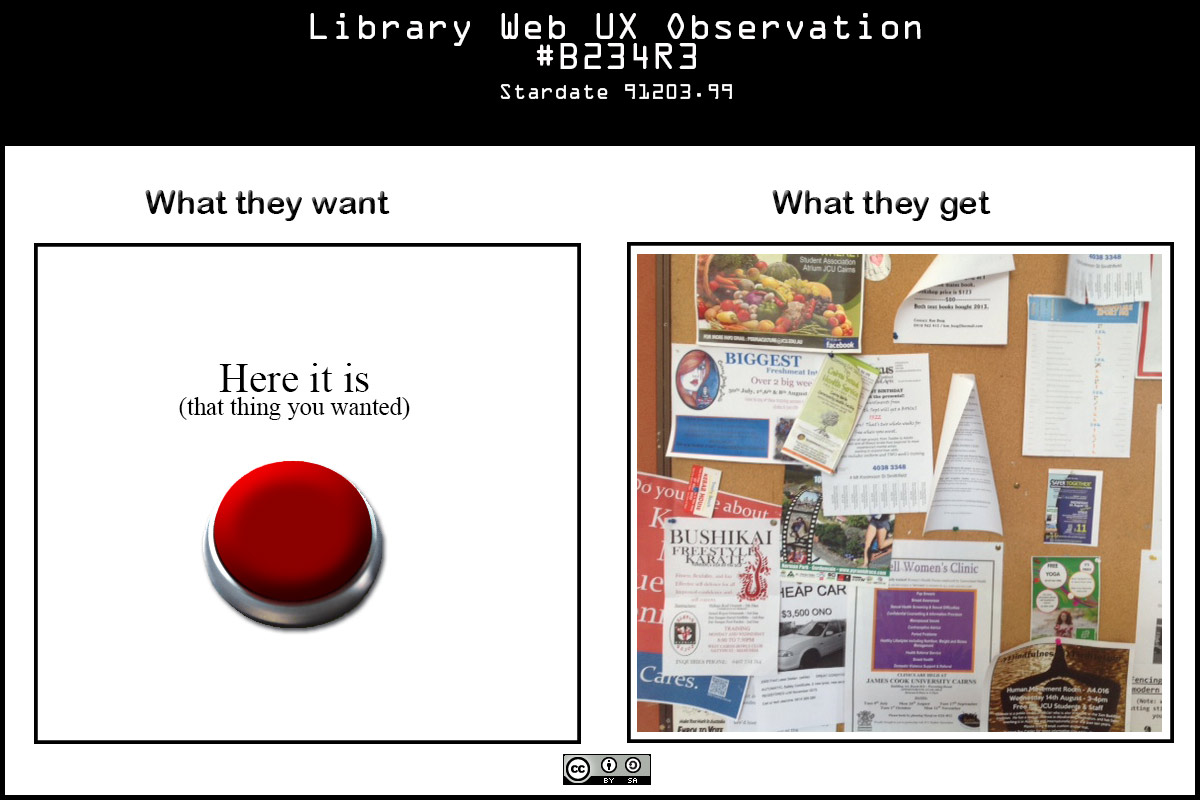
I am turning into a cranky old man - I can only apologise to my colleagues for having to put up with my tirades. They seemed to like Steve Krug's 'Don't Make Me Think', but the home page remains a regular battleground. I know compromises have to be made - but the compromises always seem to cost the users.  So to vent some steam and publicly apologise for my crankiness I resort to faux visualisation:

This is what you want, this is what you get CC-BY-SA Alan Cockerill

Monday, July 29, 2013

Shifting shores of digital music

Just some random thoughts sparked by seeing the 'Spotify is killing iTunes' story in the Australian Financial Review that got a mention on ABC24 this morning.

First it was underlining what you read in the tech press about the future all the time, i.e. things are changing quicker.

That the iTunes store has moved from being the snarky young punk the of music distribution business to an overlord in decline, in barely a decade,  is semi-startling.

The ultra-personalised digital world is here, well it's been here for a while but now it's slapping us in the face.

There are some pretty obvious parallels between the ebook and music publishing businesses. What significance for libraries does the apparent coming triumph of streaming/rental over download/own have for us?

Does our ingrained love of the book (the owned object containing fixed information) have as much cachet with Gen Z as it does with boomers? Will information be completely fluid, will all knowledge be a constantly moving mashup?  Maybe it is already. Maybe it always was.

Extrapolating on the moves:
  • from ownership, to rental, to instant access; 
  • from album to song;  
  • from labels dictating taste on large scale to an explosion of gatekeepers directing increasingly specialised taste groups; 
  • from music news from formal publishing and broadcast channels to social media-enhanced word-of-mouth
  • from the recording being the income generator to being merely a promotional tool for gig attendance
 I had a vision.

A vision where a cadre of multitalented individuals visit tiny online communities, opening their ears to great sounds from far off (out) places and moving to the next community.  Ladies and gentlemen, I give you the digital troubadour.


Thursday, July 18, 2013

Random thought: The limits of Google Analytics - it's just data, not information

I'm still wading through Google Analytics to get an idea of how the web site is used so I can have some 'evidence-based' proposals for the site home page and persistent navigation.

One thing that I'm pondering after my last blog post is referrals from Search Engines. If a page is linked to much more often from a search engine results page (SERP) than from another page in your site does that indicate your site is failing the user, or that the user prefers to use a search engine?

If a page is a common exit point does that mean it satisfied the user need, or did it just frustrate them enough to give up?  Does an elongated 'time on page' mean the content engrossed the reader or that they glazed over into catatonia?

If your total page hits go up down after a redesign does that mean you lost popularity or your site is providing the required content with a lot less clicks?

I think I could argue two opposite sides to almost anything Analytics appears to hint at - each supposition on a facet of Analytics would probably make an ideal topic for a formal debate in the vein of 'can money by happiness' or 'is honesty the best policy'

The answer is site Analytics on their own are ambiguous guides to user behaviour - you really need to observe, consult and 'know' your users. 

Analytics' value is in aggregating data so you can visualise behaviours that prompts you to formulate questions like WHY IS IT DOING THAT? IS THAT A GOOD THING?

If only users could be consulted in large numbers at any time that was convenient to me.

PS GA has some tables of Google Queries mapped against how often a page from your site  appeared in a SERP and how often one of your pages was clicked on, referred to as CTR (Click Through Rate).  It makes for interesting perusing, maybe one approach would be to interpret user goal from the search, and then see how closely the target page matched or referred to the goal.  An iterative approach that would probably improve user experience over time, but it would be difficult evaluate the impact.

Analysis of that information is making me think about using Summon's Best Bets